
- You are here:
- Home »
- Blog
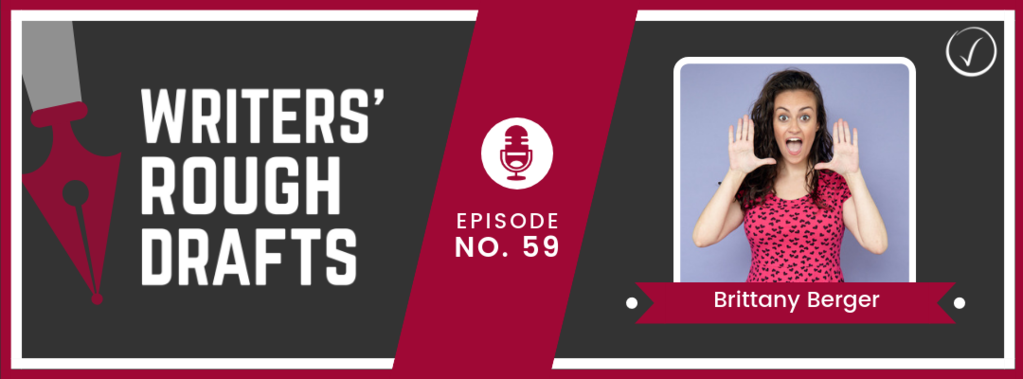
Writers’ Rough Drafts – Episode #59 With Brittany Berger
Or listen on: iTunes| Stitcher| Spotify| Google Play| Download
Brittany Berger is a content marketing consultant, mental health advocate, and productivity unicorn. After working herself into a massive hole of burnout as a freelance writer, solopreneur, and head of content with startups and tech companies like Mention, she realized there had to be a better way to get creative work done without breaking herself. She was producing three to five in-depth, high-quality, long-form articles a week, but she was sick and tired—mentally and physically.
Taking a bit of a leap, she decided to make her own health and well-being a priority, adapting many of the processes and systems she applied to her creative work to her personal self-care. Eventually, she started the website and community Work Brighter, a place for creators who want to push their “work smarter” mentality into a place of even better productivity, which makes room for “unproductive” things like rest, self-care, and fun. She still puts out a ton of writing and content, with thousands of bylines under her belt, but she’s found creative ways to do that as well.
Continue reading
Staying Motivated as a Professional Writer and Parent
American writer Alice Walker once said that writers should have only one child, because “with one you can move. With more than one you’re a sitting duck.” Yet, with Statista reporting that almost 20 million U.S. families have two children or more, it doesn’t appear that the nation is following Walker’s advice.
Still, if you are a parent-cum-professional writer, it can be difficult to stay motivated to write, regardless of how many children you have. After all, you can’t just pick up your laptop whenever the mood takes you when your kids need bathing, entertaining, or a clean diaper.
But there’s no need to worry! It is entirely feasible to combine parenthood and writing, as long as you know how. This is precisely what this post will help you with.
The tips that follow will ensure that you’re eager to start your new writing project even after a long day of parenting.
Continue reading
Writers’ Rough Drafts – Episode #58 With Rohit Bhargava
Or listen on: iTunes| Stitcher| Spotify| Google Play| Download
Rohit Bhargava is a trend curator, innovation and marketing expert, and author of six best-selling books (including the Wall Street Journal bestseller Non-Obvious). As founder of the Non-Obvious Company, he focuses on marketing disruption and innovation in the world, helping individuals and businesses learn how to be more interesting by focusing on things that are … well … not-so-obvious.
His books cover a wide range of topics that include the future of business, branding with personality, and why leaders always eat left-handed. Previously, he spent 15 years as a marketing strategist for international heavyweights like Leo Burnett and Ogilvy. He also manages to squeeze in time to lecture at Georgetown University (with a hugely popular course that explores the connections between marketing and storytelling) and speaks to sold-out audiences into the tens of thousands.
Continue reading
Editing Techniques for Writers with ADHD
Let’s pretend you live and breathe writing: Your blog is a labor of love, you’re passionate about the YA novel you’ve been writing for months, and you enjoy writing articles for your clients. But also imagine this: You’re easily distracted by random thoughts, overlook important directions, and miss crucial details you were supposed to include.
Both scenarios are the reality for professional writers with attention deficit hyperactivity disorder (ADHD).
ADHD is a neurodevelopmental disorder that restricts a person’s ability to concentrate and control impulses. It’s not a simple childhood disorder; among adult cases, 41.3% are deemed severe, according to the CDC.
It can seem impossible to edit long-form writing like a feature article, an educational e-book, or even a novel with ADHD. You have to have the commitment, patience, and detailed precision to make your draft as clean and reader-friendly as possible, especially if you don’t have an editor or proofreader. However, you don’t have to let ADHD control your editing time. There are ways to mitigate your symptoms so that you can edit your long-form document no matter how close to the deadline it is.
Continue reading